§1.1 Systems Architecture
What is the CPU, how does it execute instructions, and what makes one processor faster than another?
The CPU is the brain of any computer — it is where instructions are fetched, decoded, and executed. Every action your program takes passes through the fetch–execute cycle: the Control Unit fetches an instruction from the address stored in the Program Counter, decodes it, and either performs arithmetic in the ALU or moves data between registers. The four named registers in OCR's spec (MAR, MDR, PC, Accumulator) each have one job, and the exam tests whether students know exactly what each one holds: an address or a value.
Performance is controlled by three main levers. Clock speed sets how many cycles per second the CPU can complete — a faster clock means more instructions per second, but also more heat and power consumption. More cores allow multiple tasks to run in parallel, but only if the workload can be split. Cache is very fast memory sitting between the CPU and RAM; a larger cache means fewer slow round-trips to main memory. These levers interact and have diminishing returns — doubling clock speed will not double performance if the bottleneck is cache size.
Key terms
What students must understand
- The purpose of the CPU: to execute program instructions via the fetch–execute cycle
- The four CPU components and what each does: ALU, CU, Cache, Registers
- Von Neumann architecture: CPU and memory are separate; both instructions and data share the same bus
- The four named registers: MAR (address), MDR (data), PC (next address), Accumulator (result)
- Distinguishing a register that holds an address from one that holds data
- Fetch–execute cycle — what happens at each stage (not byte-level register-passing detail)
- Clock speed: cycles per second (GHz); higher → more instructions per second; also more heat
- Number of cores: each core can run a different process; parallel workloads benefit most
- Cache size: faster than RAM; larger cache → fewer slow memory accesses; expensive
- Embedded systems: dedicated single-function computers; typically low power, often no display or OS
- Examples of embedded systems: washing machine controller, traffic lights, pacemaker, car ABS
Diagrams
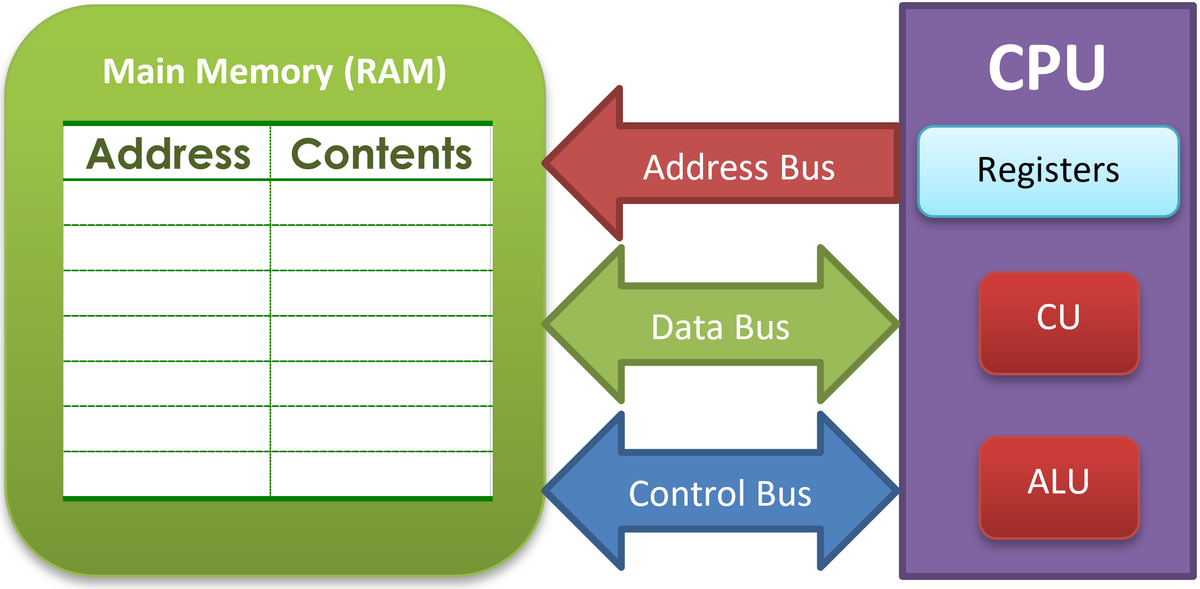
Diagrams: PG Online (Paul Long), OCR J277 textbook. Used under the school site licence.
Linking questions
- Where does the CPU store programs and data when they are loaded? → §1.2 Memory and Storage
- How does an OS manage the CPU and its resources? → §1.5 Systems Software
Practice
- §1.1 Systems Architecture practice questions — 3 printable question sets from the PG Online textbook pack