§1.3 Computer Networks, Connections and Protocols
How do computers communicate, and what rules govern data transfer across networks?
A network is two or more computers connected to share resources and communicate. A LAN (Local Area Network) is confined to one building or site and uses hardware owned by the organisation; a WAN (Wide Area Network) spans large geographical distances and typically uses infrastructure owned by a third party (the Internet is the world's largest WAN). Networks can be arranged so that one central server provides services to client computers (client-server) or so that all computers share equal roles and resources directly (peer-to-peer).
Protocols are the rules that govern how data is packaged, addressed, and delivered. TCP/IP handles the overall routing of data across the Internet; HTTP and HTTPS govern web page transfer; FTP is for file transfers; SMTP/POP/IMAP handle email (send, retrieve-download, retrieve-leave-on-server). A DNS (Domain Name Server) converts human-readable URLs into IP addresses — without it you would need to remember a number like 142.250.185.68 instead of google.com. The concept of layers allows different parts of the protocol stack to be changed independently, like swapping one part of a machine without rebuilding the whole thing.
Key terms
What students must understand
- LAN vs WAN: definition, examples, key differences
- Factors affecting network performance: bandwidth, number of devices, interference (wireless), latency
- Client-server: one server provides services; clients request them (centralised control, easy management)
- Peer-to-peer: all computers equal; each can share resources (cheaper, but harder to manage)
- LAN hardware: WAP (wireless access point), router (connects LAN to WAN), switch (connects devices within LAN), NIC (each device needs one), transmission media (cables or Wi-Fi)
- Internet: a worldwide network of networks; web servers host pages; clients request them
- DNS: multiple Domain Name Servers form the system; converts URL to IP address
- Cloud: provision of storage, software, or processing over the internet; pros (accessible anywhere, scalable) and cons (needs internet, privacy/security concerns)
- Star topology: central switch/hub; one device failing doesn't affect others; switch fails → all down
- Mesh topology: every device connected; very resilient; expensive and complex to cable
- Wired (Ethernet): fast, reliable, secure; less flexible
- Wireless (Wi-Fi, Bluetooth): convenient, portable; slower, more interference, easier to intercept
- IP addressing: IPv4 (4 × 8-bit numbers, e.g. 192.168.1.1); IPv6 (8 × 16-bit hex groups, for more devices)
- MAC address: unique hardware address assigned to a NIC; 6 pairs of hex digits; used within a LAN
- Encryption: scrambles data so only intended recipient can read it; secures wireless connections
- Protocols: TCP/IP, HTTP, HTTPS, FTP, POP, IMAP, SMTP — know the purpose and key feature of each
- Layering: protocol stack divided into layers; each layer handles one aspect; can be changed independently
Diagrams
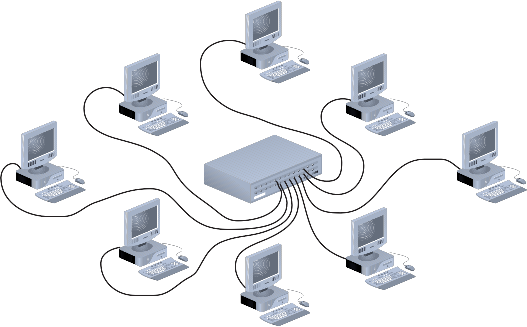
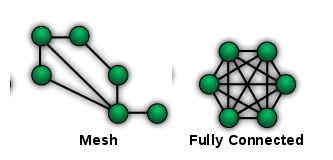
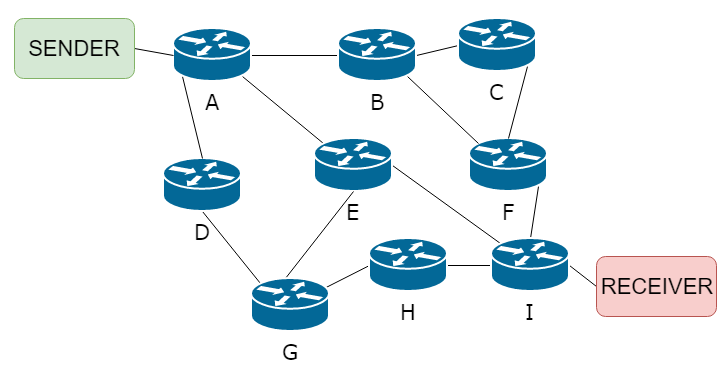
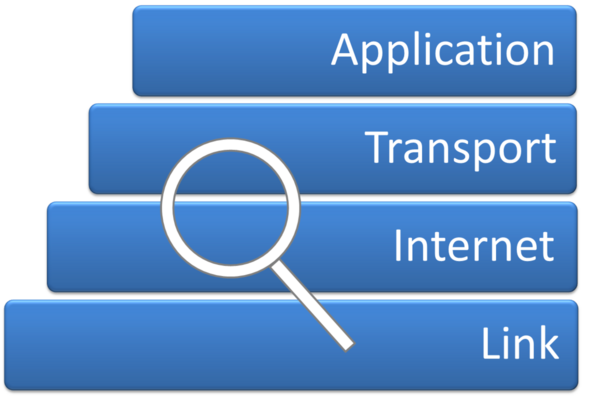
Diagrams: PG Online (Paul Long), OCR J277 textbook. Used under the school site licence.
Linking questions
- What threats exist to data transmitted across a network? → §1.4 Network Security
- How do HTTPS and encryption connect to security principles? → §1.4 Network Security
Practice
- §1.3 Computer Networks, Connections and Protocols practice questions — 3 printable question sets from the PG Online textbook pack